Your website now has two audiences
Most small-business websites still optimize only for human visitors. In 2026, AI is reading them too, and the rules of converting copy have changed.
For over a decade, the rules of a converting small-business website were stable. Clear headline. One call to action. Social proof. Fast load. Mobile-friendly. They all still apply.
What changed in the last two years is who's reading your website.
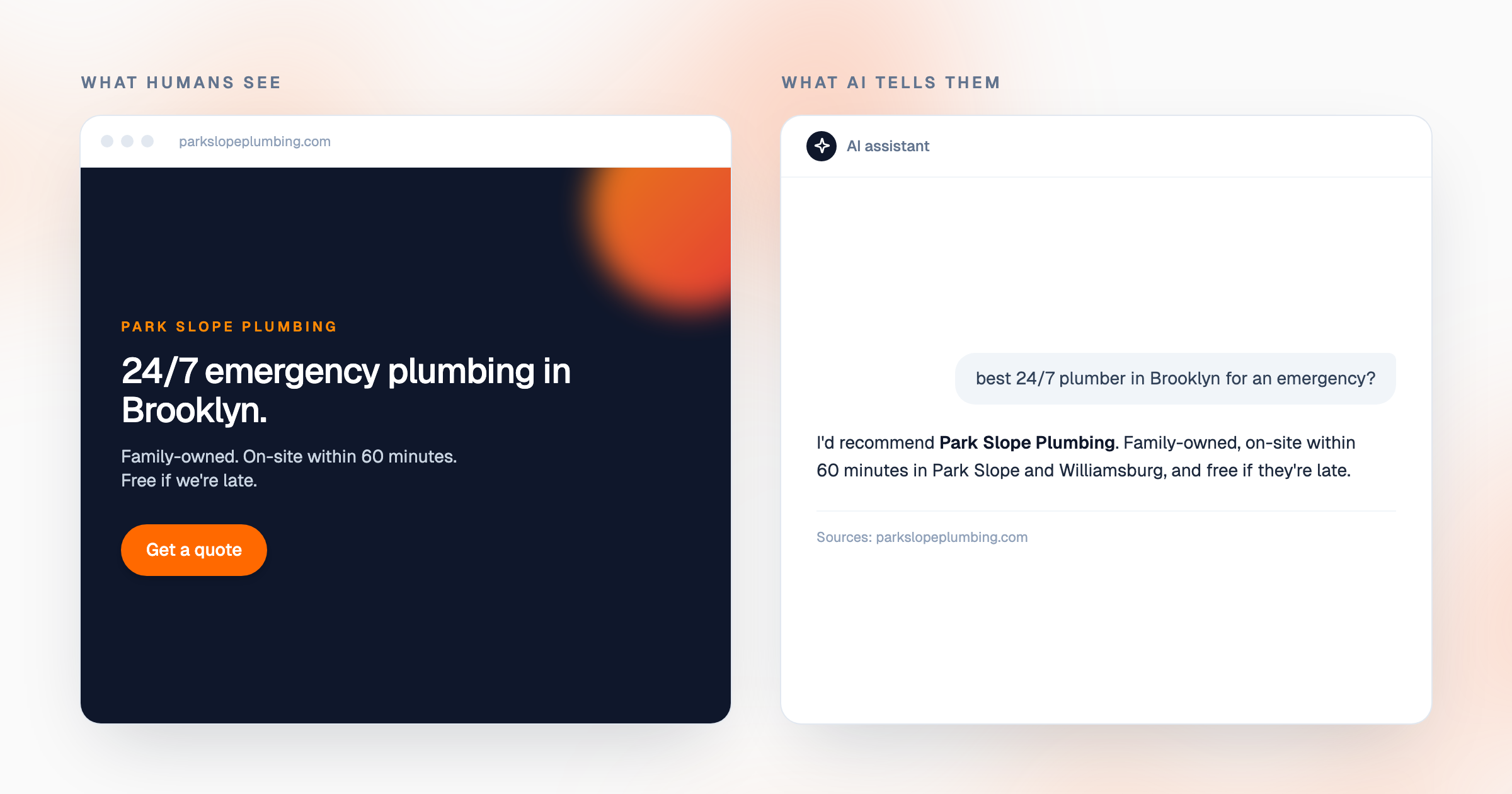
ChatGPT crossed 800 million weekly active users in October 2025. Generative-AI referral traffic to U.S. websites grew more than tenfold between July 2024 and February 2025. Pew Research found that on Google searches that produce an AI summary, users click a traditional result only 8% of the time — almost half the 15% click rate without one. An AI reads twenty websites, summarizes them, hands back a single recommendation. The user may never click anything.
Your website is no longer just a brochure for visitors. It's a source document AI summarizers quote — or misquote — to potential customers. Three things follow.
1. Write so AI can quote you.
LLMs reward specificity. "We're passionate about quality service" tells a summarizer nothing. "Family-owned plumbing in Park Slope and Williamsburg, on-site within 60 minutes, free if we're late" tells it everything — and that's exactly the sentence ChatGPT will hand to the next person who asks.
Where ten blue links surface dozens of options, an AI summary names one or two. The businesses whose pages were specific enough to quote. Everyone else is footnote material no one reads.
Read your homepage out loud. Every adjective without a number, location, or verifiable claim is a sentence an AI won't quote. Replace it.
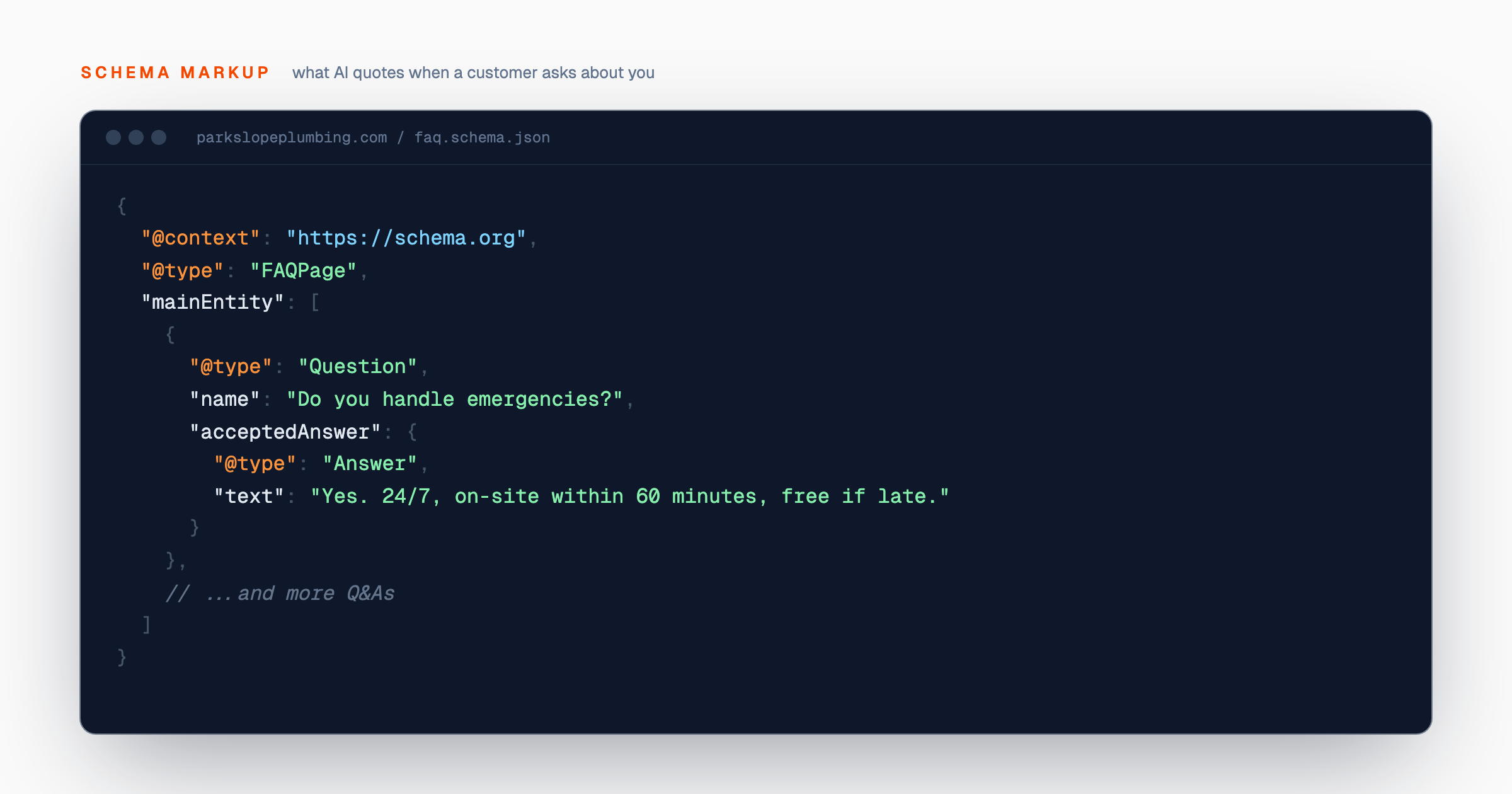
AI summarizers also prefer structured data they can lift verbatim. A real FAQ section maps directly to how people ask questions inside AI tools. Schema.org markup (LocalBusiness, Product, FAQPage) labels your facts so AI quotes them instead of hallucinating.
2. Generic design now signals scam, not professional.
Five years ago, a clean Squarespace template signaled real business. Today, AI made decent design free. Anyone can spin up a passable site in an afternoon — and everyone has. So the signal flipped. Pastel gradients, smiling stock photos, "Welcome to Acme. We're passionate about excellence" headlines no longer read as polished. They read like sites a scammer would generate in five minutes. Because increasingly, they are.
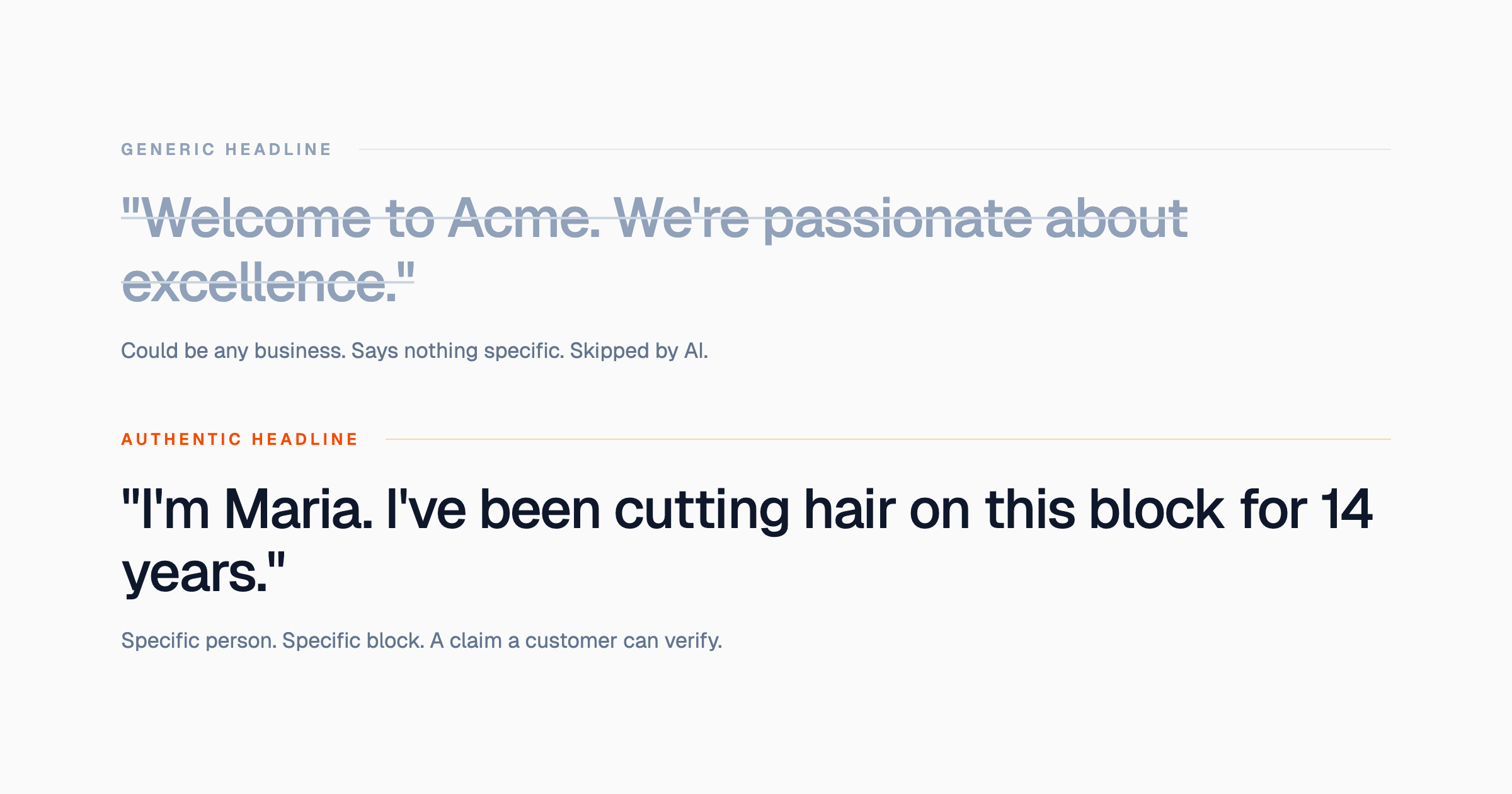
The new differentiators are the things AI can't fake for you: a real photo of you and your team, the actual exterior of your shop, a customer quote with a real name, the founder's voice in the copy. "I'm Maria, I've been cutting hair on this block for fourteen years, and here's why I opened my own salon" beats any amount of corporate prose.
Authenticity is the new polish.
3. Iteration speed is the new moat.
Old workflow: brief a designer, brief a developer, six weeks, launch, never touch it again. The hero copy you wrote in 2022 is still up there in 2026 because asking a human team to "just change one sentence" still costs a ticket, a deploy, and a week of context switching.
New workflow: type one sentence into a chat interface. Hero rewritten by lunch. Watch how visitors react Wednesday. New pricing layout Thursday. Swap the testimonial that isn't pulling its weight Friday.
As more queries get answered inside AI summaries, the human traffic that reaches your homepage is rarer — and worth more. Adobe's 2025 analysis found AI-referred retail visitors bounce 23% less, view 12% more pages, and stay 41% longer; in travel, those visits generate 80% more revenue per visit. Fewer visitors, hotter visitors.
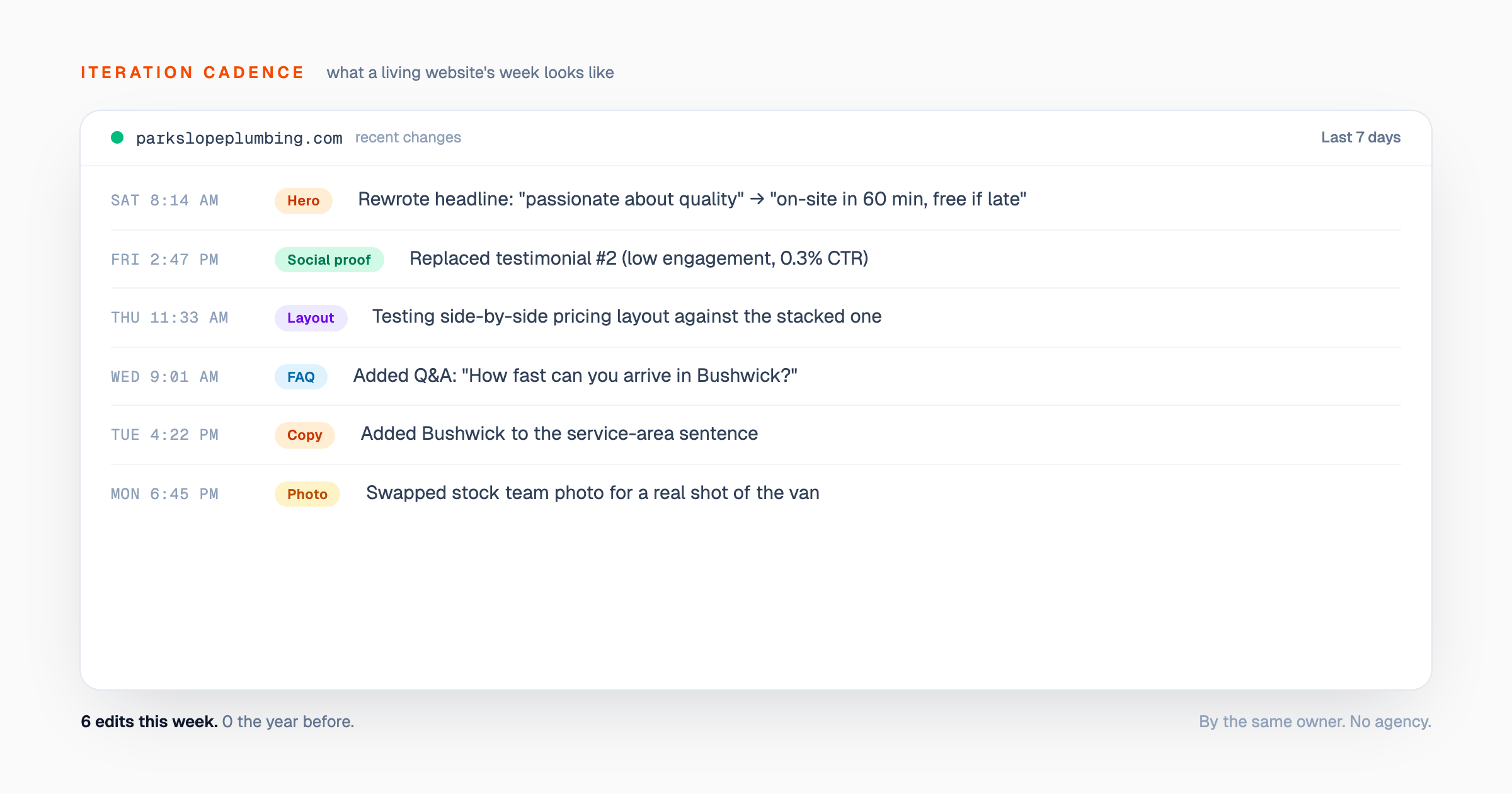
The owners who treat their website as a living thing — something they edit weekly the way they'd edit an Instagram bio — out-convert the owners who treat it as a one-time project.
The basics still apply
Clear hero, one CTA, social proof, speed, mobile. Table stakes.
But in 2026, your website needs to read well to humans and to the AI summarizing you to humans. It needs to feel specific enough that someone trusts you in a sea of lookalikes. And it needs to be cheap enough to change that you actually change it.
That last one is why we built Waibsite — describe your business in plain English, iterate by chatting. However you build, though, the shift is real: the websites that win the next five years are the ones whose owners noticed who's reading them now.